Introduction

Marcel Angenvoort

2025-01-02

Why learn Numerical Linear Algebra?

  • Numerical linear algebra is the foundation of scientific computing
  • it deals with numerical approximation of linear systems and Eigenvalue problems
  • techniques for solving PDEs often lead to a system of linear equations
  • many applications: signal processing, computational physics, data science, …

About this Course

Target Audience:

  • Students in math/physics/engineering
  • Engineers who want to gain a deeper understanding of numerical algorithms
  • anyone who is interested in scientific computing

Prerequisites:

  • solid knowledge of Linear Algebra
  • basic programming skills (Julia/Python/MATLAB)

Syllabus

  • Week 1 – 5: Introduction to Julia
  • Week 6 – 10: Algorithms for dense matrices
    • Perturbation theory
    • Direct solvers for linear systems
    • Iterative solvers for linear systems (Gauss-Seidel)
    • Calculation of Eigenvalues (power method)
  • Week 11 – 26: Algorithms for sparse matrices
    • Sparse LU-decompostion
    • Sparse matrix ordering algorithms
    • Krylow methods (CG, BiCGStab, GMRES)
    • Special iteration methods (multigrid, domain decomposition)

Note

The exact structure of this course is subject to change and may vary.

Theoretical Textbooks

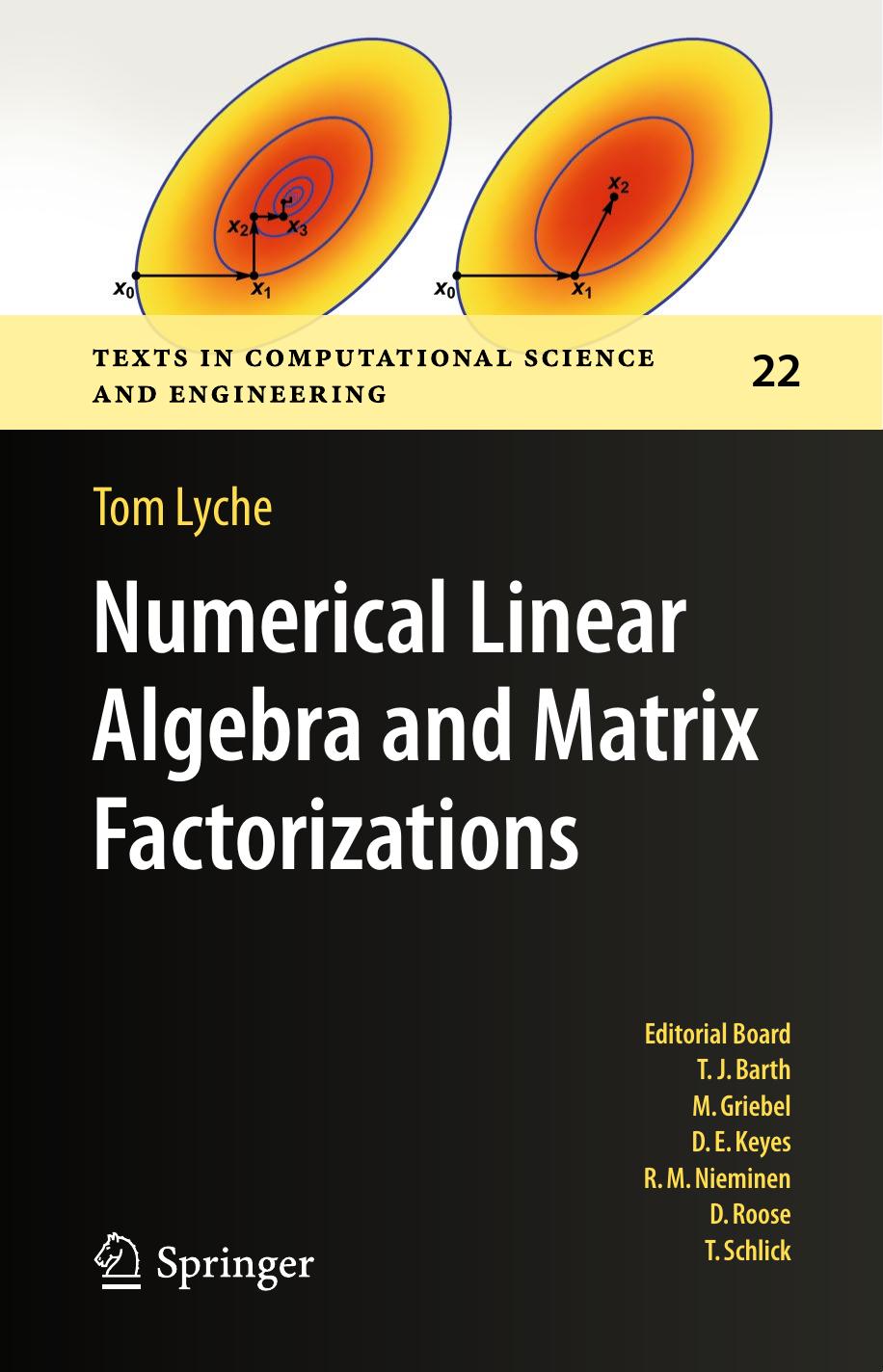
Practical Textbooks

Advanced Textbooks

Introduction

In this course we will study the problem of linear systems of equations \[ A\mathbf{x} = \mathbf{b}, \]

where \(A \in \mathbb{R}^{n \times n}\) is an invertible matrix, \(\mathbf{b} \in \mathbb{R}^n\) is a given vector, and \(\mathbf{x} \in \mathbb{R}^n\) is the solution that we are looking for.

During the study of numerical methods, we are interested in the following questions:

  1. Time complexity: How expensive is the algorithm, i.e. how much time does it take to compute?
  2. Stability/Error estimation: How does perturbation of the input affect the solution?
  3. Structure: Can we exploit the structure of the matrix (e.g. symmetric and positive definite)?
  4. What if the system is over- or underdetermined, i.e. does not have a unique solution?

Examples for Linear Systems

Linear equations appear almost everywhere. Here are some examples of applications where such linear systems are used.

See also: (Meister 2015, chap. 1), (Rannacher 2018, sec. 0.4) and (Wendland 2018, sec. 1.1)

1. Partial Differential Equations

The Poisson equation is one of the simplest differential equations. It describes the electric potential in a capacitor with a given charge density.

\[ \begin{aligned} - \Delta u &= f, && \text{in $\Omega$}, \\ u &= 0, && \text{on $\partial\Omega$} \end{aligned} \]

Here, \(\Omega := [a, b]^2 \subseteq \mathbb{R}^2\) is the domain of the problem, and \(u = 0\) is the (Dirichlet) boundary condition.

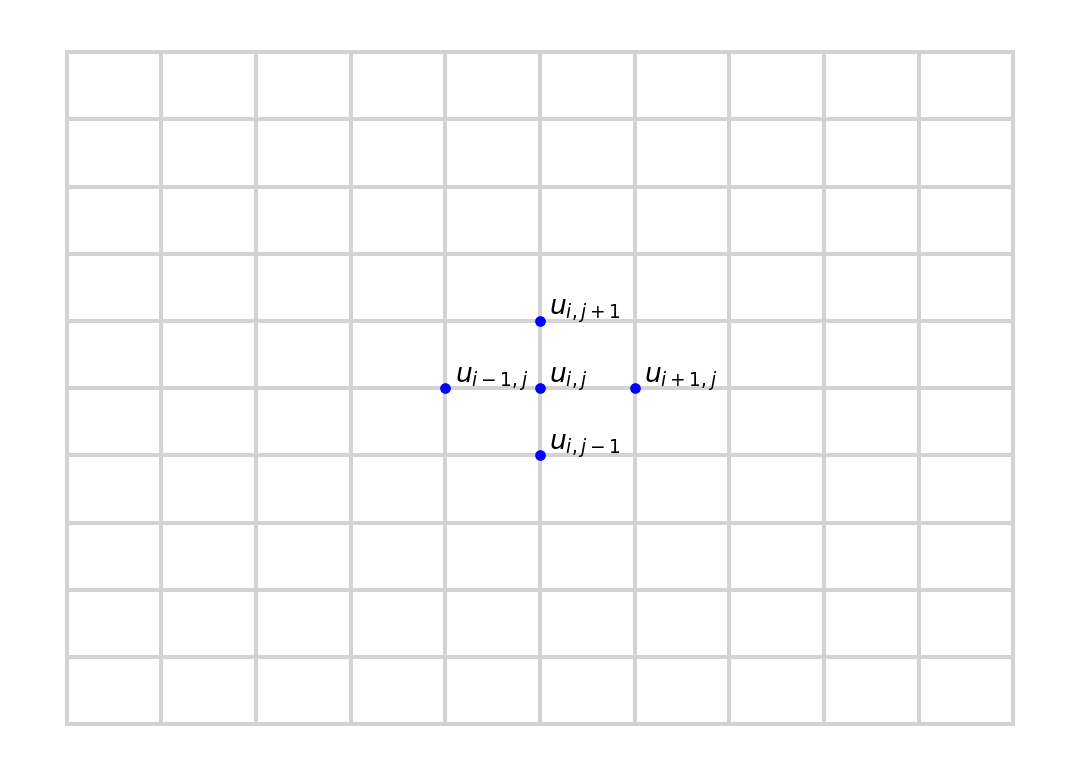
To solve this equation using the finite difference method, we must first discretise the domain. A simple approach would be to use a regular grid as shown in the figure below.

Code
#
import numpy as np
import matplotlib.pyplot as plt

x = np.linspace(0, 1, num=11)
y = np.linspace(0, 1, num=11)
X, Y = np.meshgrid(x, y)

# Plot the FDM mesh
plt.plot(X, Y, color="lightgray")
plt.plot(X.T, Y.T, color="lightgray")

# Annotations
plt.text(0.41, 0.51, "$u_{i-1,j}$")
plt.text(0.51, 0.51, "$u_{i,j}$")
plt.text(0.61, 0.51, "$u_{i+1,j}$")
plt.text(0.51, 0.41, "$u_{i,j-1}$")
plt.text(0.51, 0.61, "$u_{i,j+1}$")

# Plot stencil
plt.plot([0.4, 0.5, 0.6, 0.5, 0.5], [0.5, 0.5, 0.5, 0.4, 0.6], ".b")

# Remove axes and spines
ax = plt.gca()
ax.spines['top'].set_visible(False)
ax.spines['right'].set_visible(False)
ax.spines['bottom'].set_visible(False)
ax.spines['left'].set_visible(False)

ax.get_xaxis().set_ticks([])
ax.get_yaxis().set_ticks([])

Regular grid for the Poisson equation

That way, we can approximate the derivatices via \[ \begin{aligned} \frac{\partial^2 u}{\partial x^2} (x_i, y_i) &\approx \frac{1}{h} \left( \frac{u_{i+1, j} - u_{i,j}}{h} - \frac{u_{i,j} - u_{i-1, j}}{h} \right) \\ &= \frac{1}{h^2} \bigl( u_{i+1, j} - 2 u_{ij} + u_{i-1,j} \bigr) \end{aligned} \]

and for the Laplacian we obtain: \[ - \Delta u \approx \frac{1}{h^2} \bigl( 4 u_{i,j} - u_{i+1,j} - u_{i-1, j} - u_{i,j+1} - u_{i,j-1} \bigr) \]

Now we regroup \(u\) row-wise into a single vector:

\[ \begin{aligned} U_1 &:= u_{1,1}, & U_2 &:= u_{1,2}, &\dotsc& & U_N &:= u_{1,N}, \\ U_{N+1} &:= u_{2, 1}, & U_{N+2} &:= u_{2,2}, &\dotsc& & U_{N^2} &:= u_{N, N} \end{aligned} \]

This leads to the linear system

\[ A = \begin{pmatrix} B & -I \\ -I & \ddots & \ddots \\ & \ddots & \ddots & -I \\ & & -I & B \end{pmatrix} \in \mathbb{R}^{N^2 \times N^2} \]

where

\[ B = \begin{pmatrix} 4 & -1 \\ -1 & \ddots & \ddots \\ &\ddots &\ddots & -1 \\ & & -1 & 4 \end{pmatrix} \in \mathbb{R}^{N \times N} % \quad \text{and} \quad % I = \begin{pmatrix} 1 \\ & \ddots \\ & & \ddots \\ & & & 1 \end{pmatrix} \]

This linear system is symmetric, positive definite and sparse.

Linear Regression

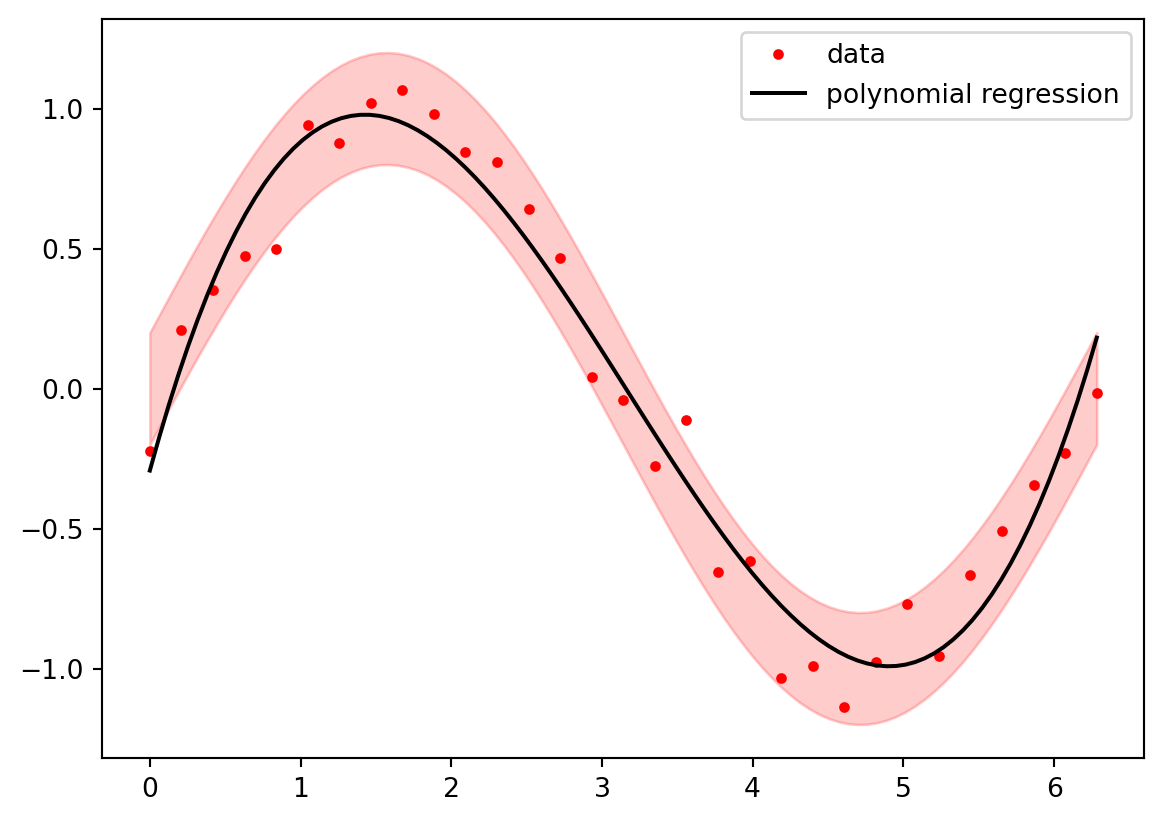
A classic problem in astronomy is the method of least squares, used by Carl Friedrich Gauss to predict the position of the newly discovered asteroid Ceres.

Code
# 
import numpy as np
import matplotlib.pyplot as plt

N = 31
sigma = 0.1

# Generate synthetic data
rng = np.random.default_rng(2025)
eps = sigma * rng.standard_normal((N,))
x = np.linspace(0, 2*np.pi, num=N)
y = np.sin(x) + eps

# Compute Polynomial regression (order 3)
p = np.polyfit(x, y, 3)

# Plot data, polyfit and confidence interval
xx = np.linspace(0, 2*np.pi, num=100)
solution = np.sin(xx)
reg_fit = np.polyval(p, xx)

plt.plot(x, y, ".r", label="data")
plt.plot(xx, reg_fit, "k-", label="polynomial regression")
plt.fill_between(xx, solution - 2*sigma, solution + 2*sigma, color="red", alpha=0.2)

plt.legend()
plt.show()

Polynomial Regression yields in a linear system of equations

Given \(N\) measurements \((x_n, y_n)\), \(1 \leq n \leq N\), the goal is to find a function

\[ u(x) = \sum_{k=1}^N c_k x^k \]

such that the mean square error

\[ E := \left( \sum_{n=1}^N \lvert u(x_n) - y_n \rvert^2 \right)^2 \]

becomes minimal.

This minimum can be obtained by solving the normal equation

\[ A^\top A \mathbf{c} = A^\top \mathbf{y}. \]

For the special case of interpolation, this matrix becomes the Vandermonde matrix:

\[ \begin{bmatrix} 1 & x_1 & x_1^2 & \dots & x_1^n \\ 1 & x_2 & x_2^2 & \dots & x_2^n \\ 1 & x_3 & x_3^2 & \dots & x_3^n \\ \vdots & \vdots & \vdots & \ddots & \vdots \\ 1 & x_n & x_n^2 & \dots & x_n^n \end{bmatrix} \]

This is a full matrix, meaning each entry is non-zero.

Convex Optimization

The example above can be generalised to more general optimisation problems.

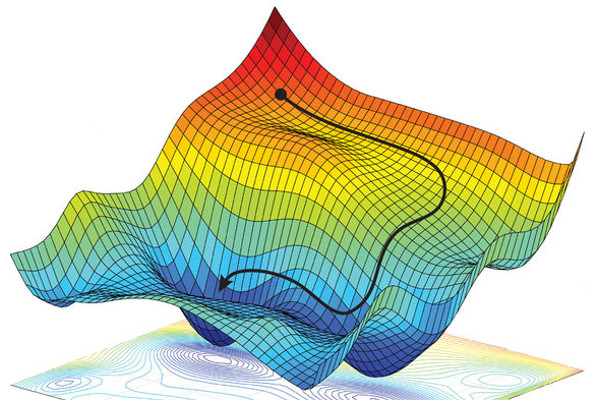
Let’s say we are given a non-linear objective function \(f\) to minimise.

\[ f(x) \overset{\text{!}}{=} \min. \]

nonlinear optimization
source: arXiv:1805.04829

Since \(f\) is minimal in \(x\) implies \(f'(x) = 0\), finding the minimum of a convex function is equivalent to finding the roots of it’s derivative, so we can use the Newton-Raphson method:

\[ x_{n+1} = x_n - \alpha \frac{f'(x_n)}{f''(x_n)} \]

where \(\alpha\) is the step size (also called learning rate).

But what if we are dealing with a multi-dimensional optimisation problem?
Then the second derivative of \(f\) becomes the Hessian matrix, and the iteration formula is:

\[ \begin{aligned} H_f \Delta \mathbf{x} = - \nabla f(\mathbf{x}_n) \\ \mathbf{x}_{n+1} = \mathbf{x}_n + \alpha \Delta \mathbf{x} \end{aligned} \]

This means that with the Newton-Raphson method we have to solve a linear system for each step.

References

Darve, Eric, and Mary Wootters. 2021. Numerical Linear Algebra with Julia. Philadelphia: Society for Industrial; Applied Mathematics.
Davis, Timothy A. 2006. Direct Methods for Sparse Linear Systems. SIAM.
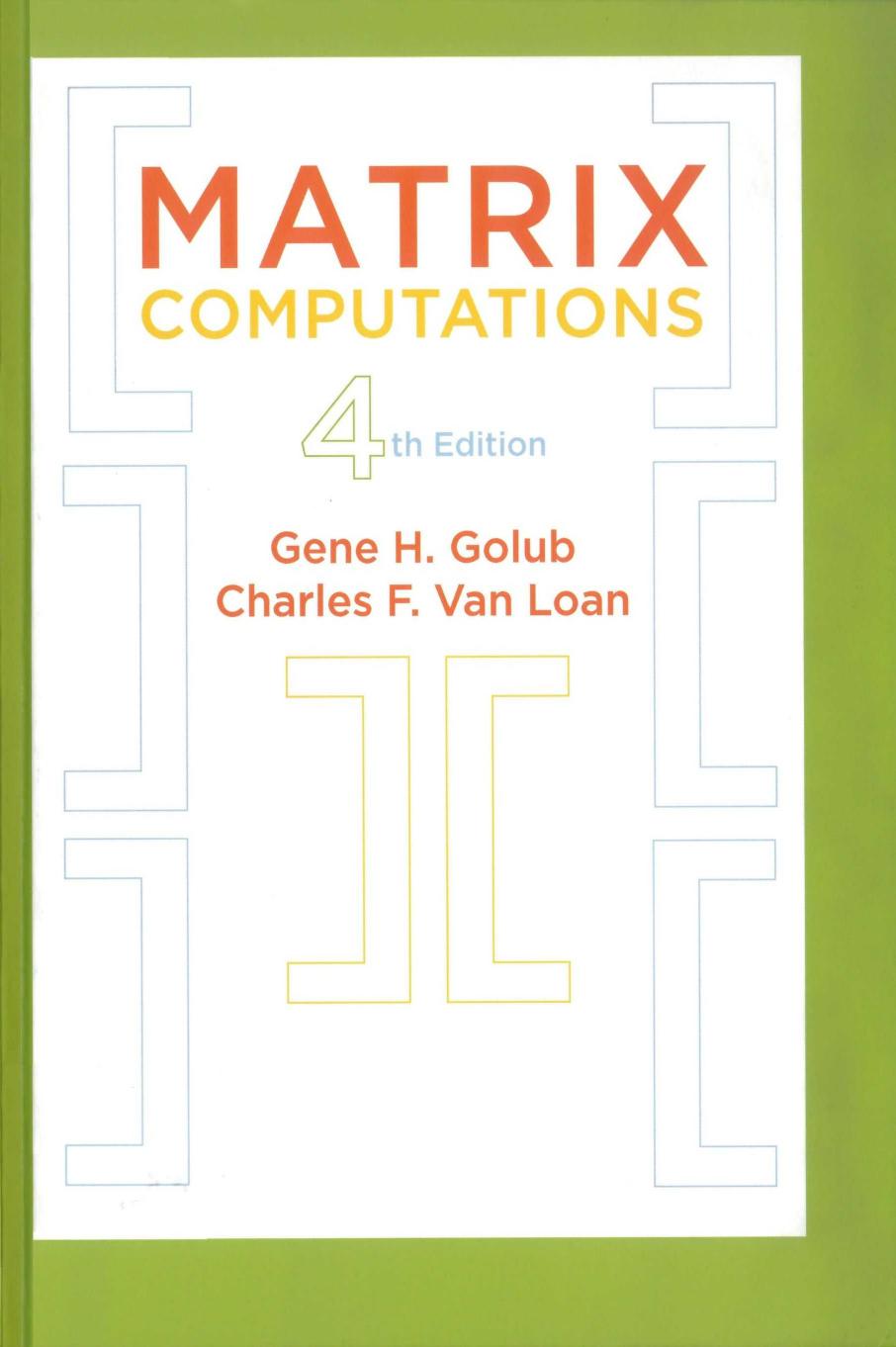
Golub, Gene H., and Charles F. Van Loan. 2013. Matrix Computations. 4th ed. Baltimore, MD: The Johns Hopkins University Press.
Hackbusch, Wolfgang. 2016. Iterative Solution of Large Sparse Systems of Equations. 2nd ed. Springer.
Lyche, Tom. 2020. Numerical Linear Algebra and Matrix Factorizations. Cham, Switzerland: Springer.
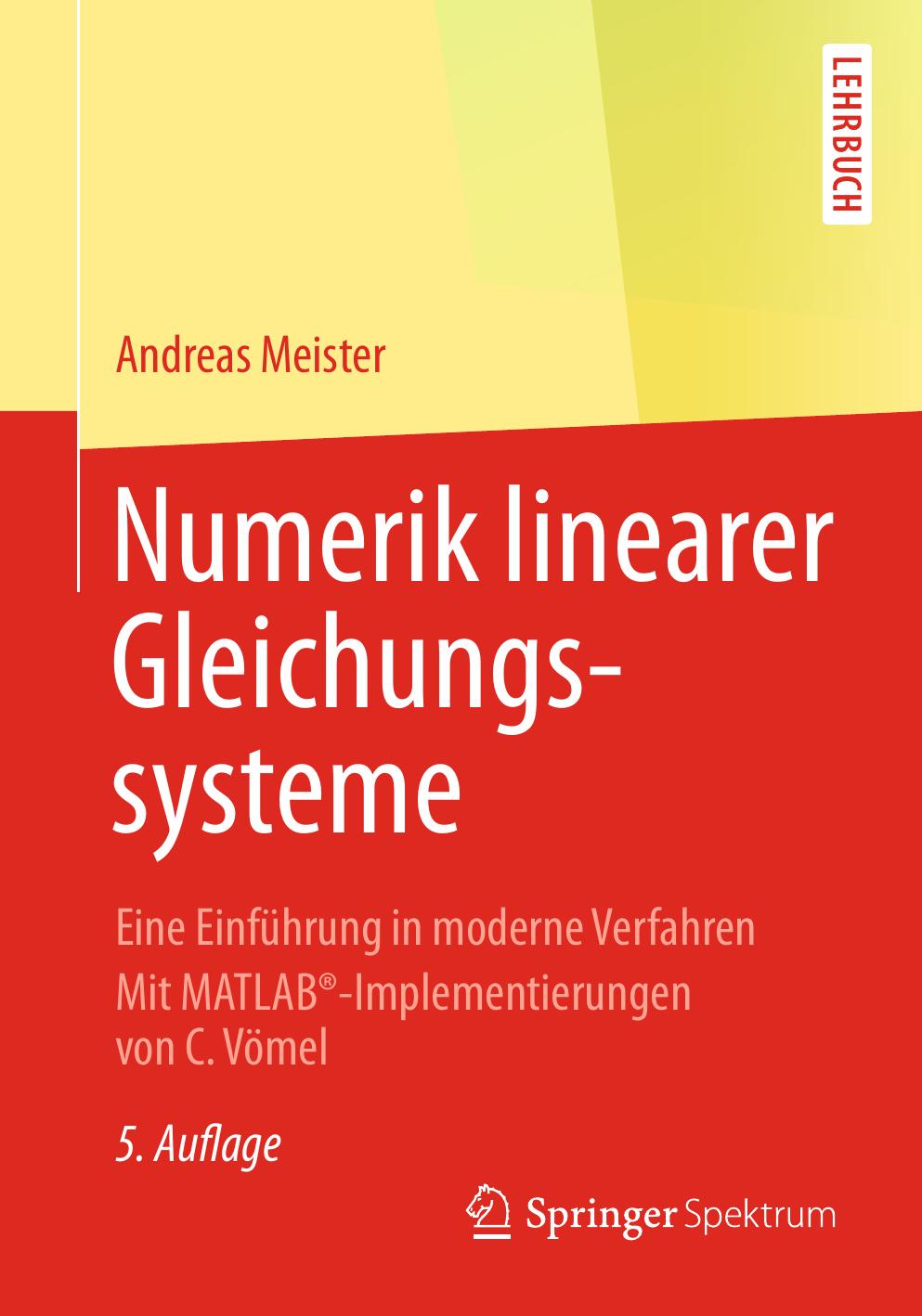
Meister, Andreas. 2015. Numerik linearer Gleichungssysteme. 5th ed. Springer Spektrum.
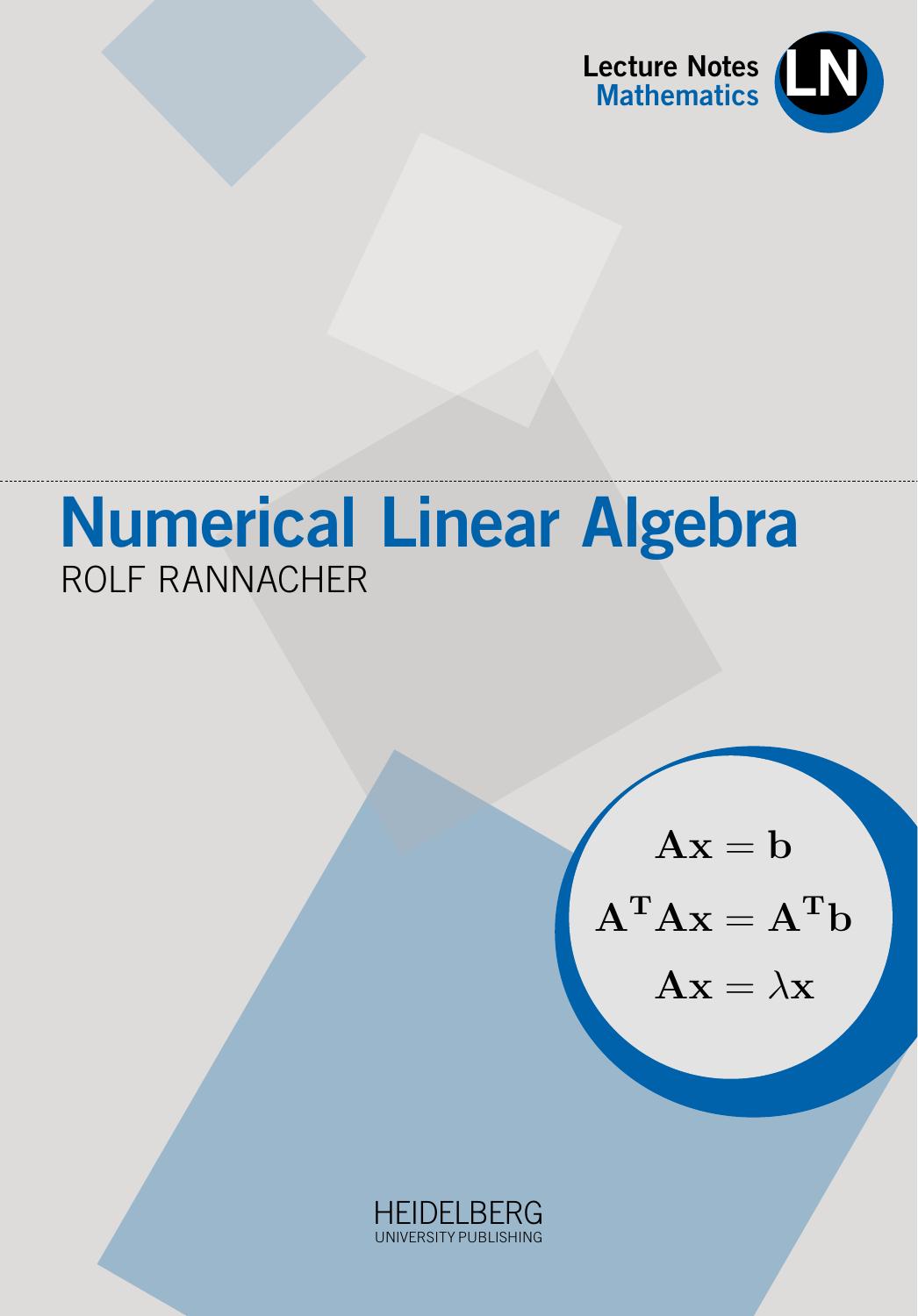
Rannacher, Rolf. 2018. Numerical Linear Algebra. Heidelberg University Publ. https://doi.org/10.17885/heiup.407.
Saad, Yousef. 2011. Numerical Methods for Large Eigenvalue Problems. 2nd ed. SIAM.
Scott, Jennifer, and Miroslav Tůma. 2023. Algorithms for Sparse Linear Systems. Cham, Switzerland: Birkhäuser. https://doi.org/10.1007/978-3-031-25820-6.
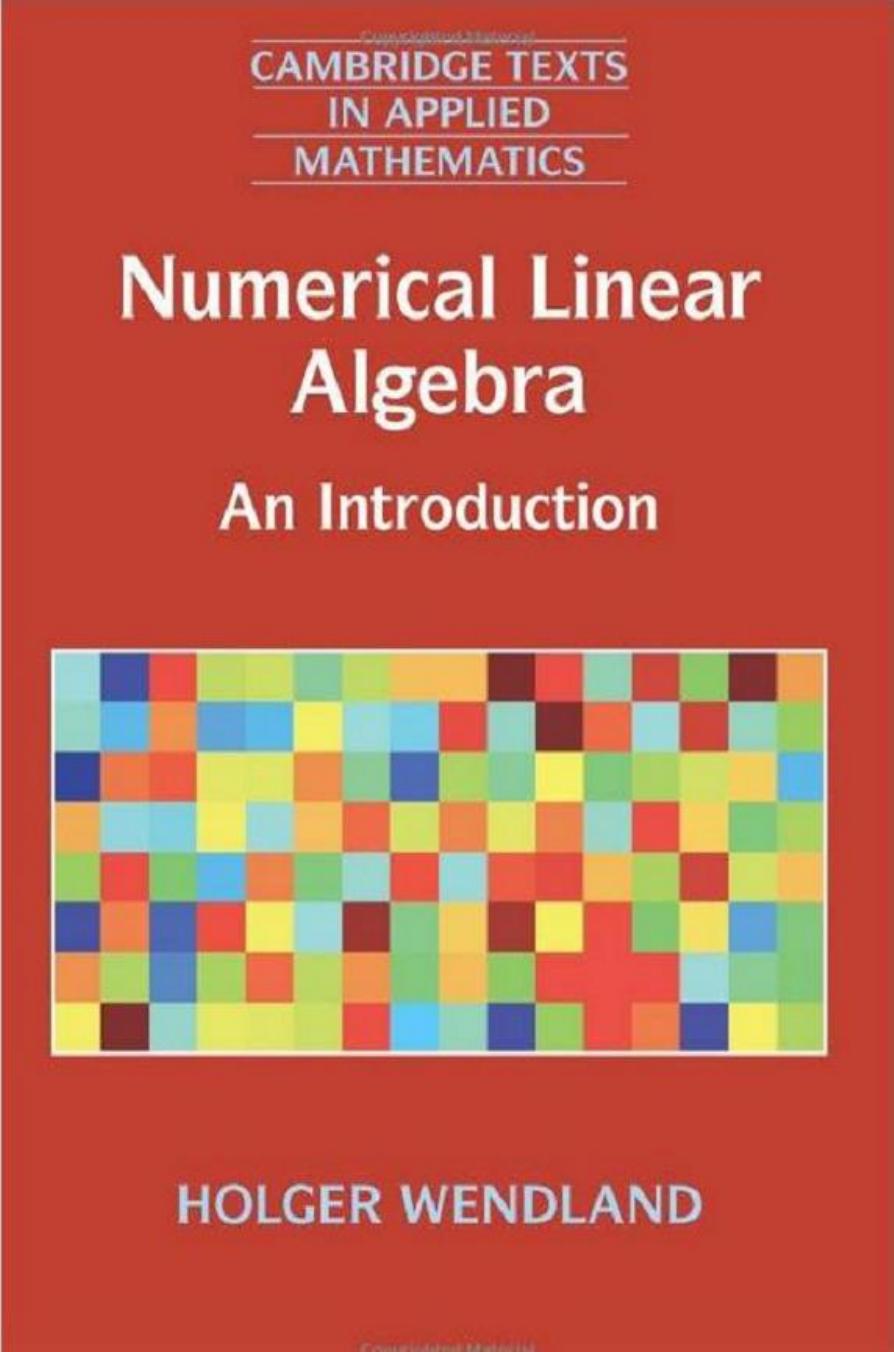
Wendland, Holger. 2018. Numerical Linear Algebra: An Introduction. Cambridge University Press.